AI in Google Ads: what we see now that we used to miss
How AI agents changed the day-to-day work with Google Ads, GA4 and BigQuery — deeper analysis, faster insights, fewer missed signals. And why it does not replace the PPC specialist, only makes them sharper.
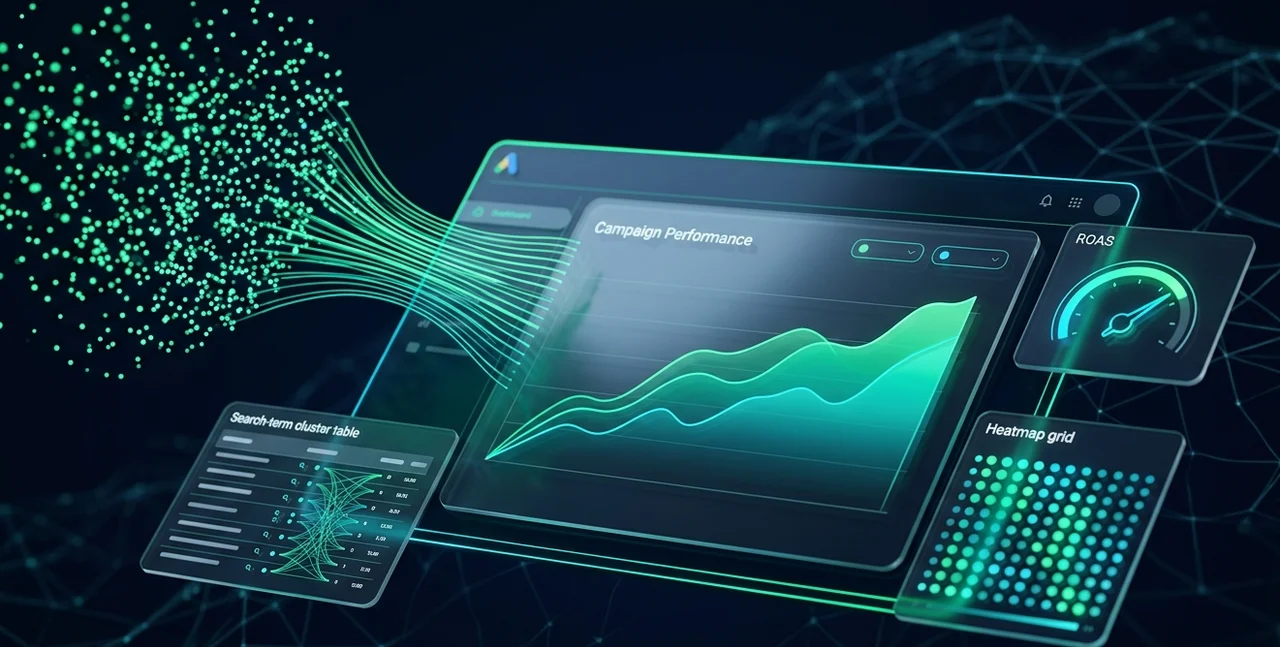
Over the last year and a half, the day-to-day work of a PPC specialist has changed more than in the previous five years. Not because of new ad formats — but because tools that used to require a whole analytics team are now in everyone’s hands.
This is not about “magic AI that runs your campaigns by itself” — that’s a different story. This is about how analysis that used to take two days now takes thirty minutes. And how that affects your ad budget.
What actually changed
AI in Google Ads is not one feature. It is several different applications, each of which frees up hours of routine and surfaces things we simply didn’t have time to see before.
Each item on its own is a small saving. Together — it’s a different depth of analysis for the same amount of time.
Insights we used to miss
The interesting part is not even the speed. It’s that what becomes visible is very different.
A few real-world examples (no brand names):
Case 1 — e-commerce, home goods. Overall Performance Max ROAS — 4.2x. Looks fine at first glance. AI-driven segment analysis showed that one product category took 70% of spend with a 2.1x ROAS, while another at 12% of spend held a 9.8x ROAS. Reallocating budget through feed signals lifted total ROAS to 5.9x within two weeks. This could have been spotted manually — but among a hundred asset groups, a human would have missed it for another month.
Case 2 — lead-gen, B2B services. Form-submit CR dropped from 3.4% to 2.8% — seems like noise. AI noticed that the drop only affected mobile users from Performance Max, and only on one of three landing pages. The cause: after a site update the “Submit” button was overlapped by the header on small-screen iPhones. A one-hour fix — and CR recovered.
Case 3 — online courses. Search campaign on the keyword “[product] course” — CTR 12%, CR 6%, ROAS 4.1x. Cluster analysis showed 38% of conversions came from the sub-cluster “[product] course reviews” — and no ad group was specifically tailored to it. After splitting it into its own campaign with adapted ads, CR rose to 9%.
AI does not surface what is not in the data — it surfaces what is already there but a human misses because of the volume. It’s not “new information from thin air” — it’s a deeper reading of what you already pay Google to collect.
What AI does not do — and why that matters
This is the part usually skipped in the enthusiastic AI articles.
- —Processes large data volumes fast
- —Finds correlations and anomalies
- —Generates creative variants and hypotheses
- —Handles routine reports and segmentation
- —Checks statistical significance
- +Understands the business context (new product, margin, seasonality)
- +Asks the right questions — AI executes, but doesn't decide what to ask
- +Validates the correctness of data and AI's conclusions
- +Owns responsibility for strategy and risk
- +Aligns actions with the client's goal, not with a metric for its own sake
An AI agent can produce a neat correlation table showing that clicks on the “discount” hint on the homepage correlate with a ROAS drop. A human sees that and understands: it’s because the discount is currently only on a low-margin product group, and that’s perfectly aligned with the client’s strategy. AI doesn’t know that — it wasn’t in the brief and didn’t see the P&L.
The biggest risk is when AI gives a wrong answer in a polished format, with numbers and a convincing tone. Without human verification, mistakes like this end up in client reports or, worse, in real budget decisions. Every hypothesis from AI analysis goes through human review — otherwise it’s just numbers without meaning.
What this means on the client side
The most important thing in all of this is not “we have cool tools.” It’s what it actually gives the business:
- Faster reaction to problems. What used to be spotted a month later (“sales seem off”) is now visible Tuesday morning after the Monday data.
- Fewer missed growth points. Every ad account has 3-5 things that could bring +15-30% to the result. The question isn’t whether they exist — it’s whether you’ll find them.
- Clearer analysis. Instead of “the algorithm did something” — a concrete hypothesis with numbers explaining why we acted exactly so.
- The specialist’s time goes into strategy, not routine. It means you pay not for “man-hours of looking at search terms,” but for thinking about your business.
AI did not make the PPC specialist’s job easier. It made it deeper. The time that used to go into pulling data now goes into working with conclusions — and that’s exactly what the client is paying for.
What this does not mean
AI agents are a must-have tool for data work today. But this does not mean:
- ❌ That Google Ads now “runs itself”
- ❌ That you can ignore metrics and rely on “the neural net”
- ❌ That less experience is fine because “AI will figure it out”
AI amplifies a specialist who already understands metrics, conversions, the analytics funnel. In the hands of someone without the basics, it produces pretty charts that lead nowhere.
It’s the same as a calculator: indispensable for an accountant, but it won’t make an accountant out of someone who couldn’t add.
Bottom line
PPC in 2026 is no longer “set up the campaign and wait.” It’s a continuous cycle of data, signals and decisions. The strength of the modern specialist is not knowing every Performance Max setting (everyone knows them now). It’s the questions they ask of the data — and how fast they get the answers.
AI gives speed and depth. Everything else — experience, context, accountability — stays with the human. That’s how productive advertising works today. No magic. Just results.
If you’d like to see what growth points exist in your own account — get in touch. The first review is free, and 70% of what’s worth changing becomes visible already at that stage.
Need help with advertising or analytics?
We will audit your account and show growth opportunities. The first assessment is free.
Discuss a project